
Wednesday, 31st June 2024.
CreditEconomy News Interview
…Over 500,000 people read our news story, number still counting

Mr. Idemudia Osaretin Joseph, FICA, EXECUTIVE DIRECTOR, WILO PUMPS NIGERIA LIMITED
WHEN ECONOMY IS BOOMING, CREDIT IS A REASON FOR IT–
Mr. Idemudia Osaretin Joseph, FICA, EXECUTIVE DIRECTOR, WILO PUMPS NIGERIA LIMITED, speaks on the impact of credit in the water pump sector and the economy at large, in this interview article of the National Institute of Credit Administration [NICA]
What has been your experience in the giving and taking of business credit in your industry?
My industry specializes in water pumps; it is mostly like engineering. We are manufacturers of water pumps and typically deal with both private and government contractors, especially the Federal Ministry of Water Resources.
We’ve been doing business mostly on credit basis due to the nature of the industry, which is a very unique one. Unlike the typical pay and pickup industry, ours is one that you need specification for certain pumps. What does that mean? You might pay an advance right now for a pump, and it may take like three to six months for that pump to be manufactured. As a result, working without credit is nearly impossible, so you find out that our industry actually cannot do without credit. A lot of clients are unwilling to commit 100% into what they have not seen.
Even after delivery, you may find that it may take another 60 to 90 days to get your balance or remaining payments from these clients.
Basically, about 80% to 90% of our customers are credit customers. While we do have cash ready clients, they are few in number and usually involve businesses and contracts with very low value because. Most of our work involves contracts worth millions of Naira and considering that we deal with government. Government business is mostly on credit because sometimes, it takes more than one year to get your full payments, even after completion of contracts. So basically, we are a credit industry here in Nigeria?
What would you say expands the economy faster, is it a credit system or cash and carry system?
“It’s a credit system. If you look at most developed countries, they operate a credit system and It has really helped their economy to grow because, with credit system, there is a quick decision to buy and that quick decision expands the market and turnover. Whether you have the money or not, if there is a need for an item, you quickly get it and make use of it.”
But the reverse is the case in a non credit ecosystem. It means that without cash, you lack purchasing power, leaving items unsold on the shelf and the producers or manufacturers are unable to make sales. This slows down the business cycle and hinders expansion of businesses. So, if you look at it critically, you will discover that most businesses rely or resort to credit facilities for expansion. It is a two-way thing, both for retailers and investors. Credit is the best way to go.
What type of economic system would you advocate for Nigeria?
If I had the powers, I will advise the government that a credit system is the best option. However, there is a clause to this. You can’t run a credit system where you do not have a good database of clients and accurate records like they do in developed countries where information on customers are accurate and easily accessible.
In Nigeria today, if you give credit for example, and the credit user or benefactor happen to change address, there is no agency in place or a means to track that change because of the failure to update records. So if I am owing someone and that person is unable to reach out to me to recover the loan, it invariably becomes a bad debt at the end of the day. We already have a credit system in place, but the percentage of people who use this is low. Also, the risk involved in credit system is quite high, but I believe that as time goes on, the country will move towards a better system.
“There must be awareness and people need to understand that taking credits does not mean it is your money until the transaction is completed and the payment cycle is complete. So there is need to create more awareness and put in place a system that allows for easy accessibility of information to those who give credit.”
From that moment you became a Fellow of the National Institute of Credit Administration [NICA], what came into mind?
Sincerely, being a Fellow of the National Institute of Credit Administration has helped me a lot.
I am responsible for overseeing business operations in Nigeria, focusing on credit management. I encounter various challenges related to managing credits and customers. To address these challenges and make more informed decisions, I sought to gain deeper insights into credit management.
When I assumed my current position, I introduced a new policy. Previously, we required new customers to pay 100% for their goods before we would take their orders. However, I observed that this policy was hindering our business growth, as it negatively impacted our turnover.
Having previously served as a financial controller, I was familiar with the figures and the implications of our policies. I realized the need to align myself with institutions and organizations that could provide me with further knowledge and insights into credit management. My goal was to upgrade my skills and share this knowledge with my team, colleagues, and others. This way, I can speak confidently about credit management and contribute effectively wherever I am
What support do you think the business community should avail to NICA?
Well for me, again, it is a two-way thing; business community should support NICA, and I believe NICA also should support the business community.
I think the business community can actually support NICA through the following detailed and concise ways, the first way is this; I see NICA as a body consisting of members who have come together to find a way around credit management and increase knowledge about credit management and administration in the country. I believe that the business communities should make it a priority to ensure that employees of these businesses, such as sales people, sales managers, auditors, credit officers, etc., are mandated to get certification. Doing this will increase the membership of NICA, contribute to its financial/fund pool which will eventually make NICA a very strong and formidable.
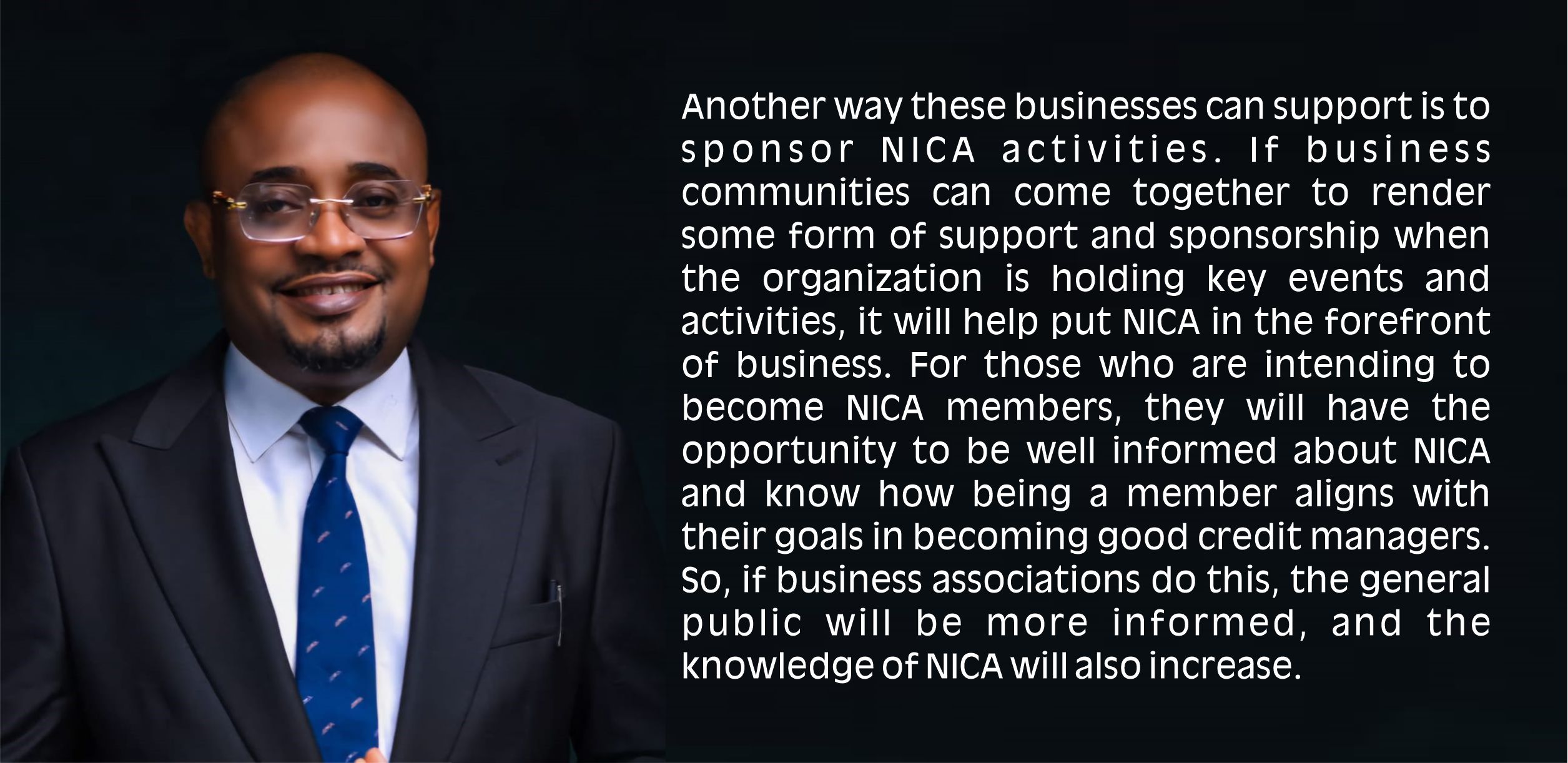
“Another way these businesses can support is to sponsor NICA activities. If business communities can come together to render some form of support and sponsorship when the organization is holding key events and activities, it will help put NICA in the forefront of business. For those who are intending to become NICA members, they will have the opportunity to be well informed about NICA and know how being a member aligns with their goals in becoming good credit managers. So, if business associations do this, the general public will be more informed, and the knowledge of NICA will also increase.”
Also, the business community can collaborate with NICA in terms of training. Trainings are very important in workplace environment. Although, not every employer expends so much in training their employees, its importance cannot be emphasized enough. You can imagine if you have a credit officer who understands credit policies and how to handle credit matters. It is also a good leverage for every business. If businesses could collaborate with NICA, it could be in the form of an in-house training, or outside trainings, I think it will help to shape the kind of employees these businesses will have, as your business is as good as the people you have. If you have an employee who is a member of NICA with some solid training and certification from the organization, be rest assured that such an employee is going to plough back the gains of the training into your business and at the end of the day, it is a win-win for both NICA the business community and the trained employee.
The business community can provide quality information to NICA. Accurate and comprehensive data from businesses can significantly enhance NICA’s credit reviews and publications. The reliability of these publications hinges on the information supplied by the business sector. By contributing detailed and precise information, businesses can ensure that NICA’s reports are accurate. Increased collaboration and information sharing will benefit both NICA and the business community.
What advice do you have for the credit community?
I think businesses should be very careful when extending credit as there is a need to conduct a thorough risk evaluation and analysis.
Credit risk analysis is very crucial because it enables businesses to determine if going into credit business is a good endeavour or not. Failure to do a credit risk analysis can be very detrimental to any business, especially in this period where we are having some serious Forex challenges due to the fluctuation of exchange rates.
For instance, most of our products are manufactured outside the country. Last year, we incurred some serious losses due to the exchange rate. Imagine if we sell a product at a certain rate and client makes payment 3-6 months later when the exchange rate would have been 2 or 3 times higher than the rate the product was sold at; it is evident that the company is going to experience a substantial loss. At this point, it is advisable to be observant and consider how much credit is made available to customers.
While businesses cannot stop granting credit, they can reduce their exposure. This is due to the current economic situation, not necessarily because granting credit is bad in itself, that is why I talk about business risk analysis. When the economy becomes more stable, businesses can decide to take on more risks. Banks for instance monitor their loan ratio at every point in time, and when there is an increase in their bad debts, they stop giving out loans.
Businesses need to continually perform risk analysis and stay informed about current changes, trends, follow up policies, reviews, CBN policies, Nigerian Ports Authority, etc., as failure to do this can lead to unforeseen issues.
Credit recovery in Nigeria is quite challenging, unemployment is also on the rise right now, and people are losing their jobs and some of these people are on credits. Even if they genuinely want to pay, they do not have the resources because their source of revenue has been cutoff.
“The challenge is a dicey one but I think it will get better and that’s one thing I tell people. When the economy is booming, it is credit.”
When the banks came in some years back and started expanding in the early 2000, they were giving loans to buy cars and do all sorts of things. Even as a banker, six months after confirmation, they will tell you anything you want to buy, they will give you loan/credit to do that, but that is no longer happening as much as it used to back then. The system has changed, even banks too are not efficient in the credit rating of their customers, and that is why you see the economy is very slow. Things are not moving; it is because there is no credit. Before, you could walk into an auto room and pick up a car for even N20m as long as you have a good job, and you can pay within four years. Currently, credit has become more expensive and less accessible.

As a chattered prestigious body of eminent credit management elites, NICA is empowered by law to, control supervise and regulate credit management profession in Nigeria; the institute preserves, promotes and protects the integrity and interests of credit business across sectors of then economy.
National Institute of Credit Administration,
Old No 1 (New No 21) Mabogunje Road, Oniru Estate, Victoria Island, Lagos Nigeria
Tel: 234-(080)-340-30160
Mobile: 234-(070)-558-53470
Office: 234-(070)-338-14790,
234-(081)-278-08900