
Monday, 9th December 2024.
CreditEconomy News Interview
…Over 500,000 people read our news story, number still counting

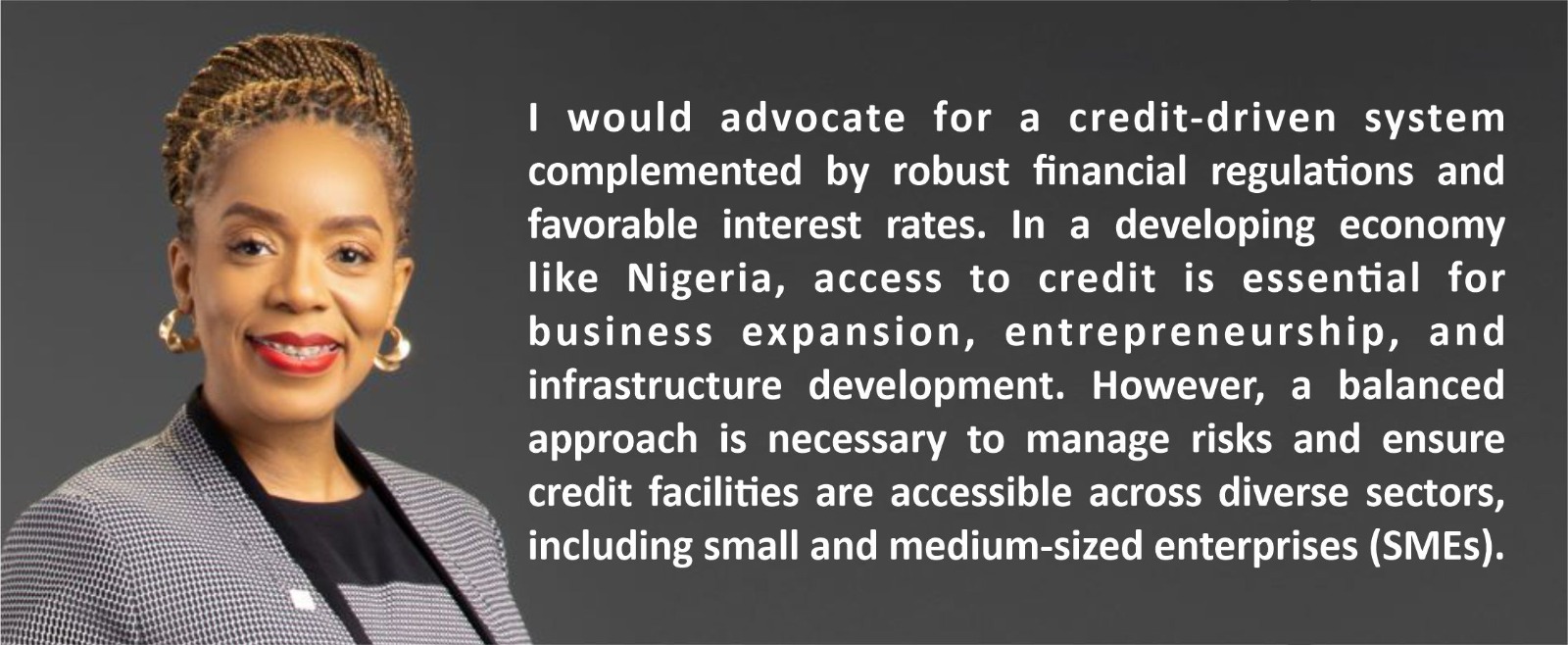
Mrs. Uzo Oshogwe, FICA
MD, Afriland Properties Plc
A CREDIT-DRIVEN SYSTEM SHOULD BE COMPLEMENTED WITH FAVORABLE INTEREST RATES– MD, Afriland Properties Plc, Mrs. Uzo Oshogwe
The Managing Director/ Chief Executive Officer, Afriland Properties Plc, Mrs. uzo Oshogwe, speaks on relevance of credit to the economy in National Institute of Credit Administration’s interview article.
What has been your experience in receiving credit lines for the business growth and development of your company?
“At Afriland Properties Plc, we have strategically leveraged credit lines to finance key real estate projects and drive expansion. Access to credit has been instrumental in executing large-scale developments, such as The Residences in Ikoyi, Iris Court in Ikeja, Afriland Complex in Lagos, and The Emporium in Port Harcourt.”
We are also utilizing credit lines to deliver projects currently under construction, including Afriland Estate in Abuja and The Residences II in Ikoyi, ensuring we efficiently meet market demands. However, securing these facilities requires meticulous planning and a strong financial track record to obtain favorable terms. Our credibility and sound governance have been crucial in aligning credit facilities with our growth objectives.
What would you say expands the economy faster: a credit system or a cash-and-carry system?
“A credit-driven system undoubtedly expands the economy faster. Credit enables businesses to scale operations, invest in infrastructure, and drive innovation without waiting for accumulated capital.”
“In real estate, for example, credit allows developers like Afriland Properties Plc to undertake large projects, creating jobs and stimulating economic activity. Conversely, a cash-and-carry system limits growth by restricting access to immediate funding, thereby slowing economic progress.”
What type of economic system would you advocate for Nigeria? A credit-driven system or something else? Explain.
I would advocate for a credit-driven system complemented by robust financial regulations and favorable interest rates.
“In a developing economy like Nigeria, access to credit is essential for business expansion, entrepreneurship, and infrastructure development. However, a balanced approach is necessary to manage risks and ensure credit facilities are accessible across diverse sectors, including small and medium-sized enterprises (SMEs).”
A thriving credit system would empower companies like Afriland Properties Plc to undertake transformative projects, contributing significantly to national growth.
Does your company give credit to its customers? How, and under what conditions?
Yes, Afriland Properties Plc offers credit to customers through flexible payment plans and partnerships with financial institutions for mortgage facilities.
For instance, in our upcoming project, Afriland Estate Karmo; a deluxe residential estate in Abuja, we provide installment payment options that make homeownership more accessible. Conditions include a down payment and a structured payment schedule. This approach ensures affordability while maintaining financial sustainability.
From the moment you became a Fellow of the National Institute of Credit Administration (NICA), what came to mind?
“Becoming a Fellow of NICA was a proud and reflective moment. It reinforced my belief in the critical role that credit management plays in fostering sustainable business growth and economic development.”
It also emphasized the importance of responsible credit practices, a principle Afriland Properties Plc upholds in its operations. I saw it as an opportunity to contribute to shaping policies that promote ethical credit management in Nigeria.
Can you distinguish NICA from other institutes? Why do you think NICA is different?
NICA stands out for its specialized focus on credit management and its commitment to fostering a culture of responsible credit practices across industries. This positions it as a critical player in driving economic growth through sound credit policies.
As a Fellow, I appreciate NICA’s emphasis on professionalism, ethical standards, and its role in strengthening Nigeria’s credit system. NICA also places significant importance on training, offering programs to ensure members are adequately equipped to perform their roles and fulfill their responsibilities.

As a chattered prestigious body of eminent credit management elites, NICA is empowered by law to, control supervise and regulate credit management profession in Nigeria; the institute preserves, promotes and protects the integrity and interests of credit business across sectors of then economy.
National Institute of Credit Administration,
Old No 1 (New No 21) Mabogunje Road, Oniru Estate, Victoria Island, Lagos Nigeria
Tel: 234-(080)-340-30160
Mobile: 234-(070)-558-53470
Office: 234-(070)-338-14790,
234-(081)-278-08900